
Where Europe's SaaS Growth Actually Happened in 2025
A full-year review of 1,750 new companies, AI-native growth, and the transatlantic shift

A year ago, claiming Europe would overtake the US in SaaS company count would have seemed premature. It happened, and the latest data shows where the growth is actually concentrated.
What started as a snapshot of the market

has now become a full-year view of how the ecosystem is evolving—which countries are accelerating, which ones are stagnating, and where AI-native SaaS is emerging fastest.
Late last year we observed something surprising: Europe had overtaken the United States in the number of SaaS companies.
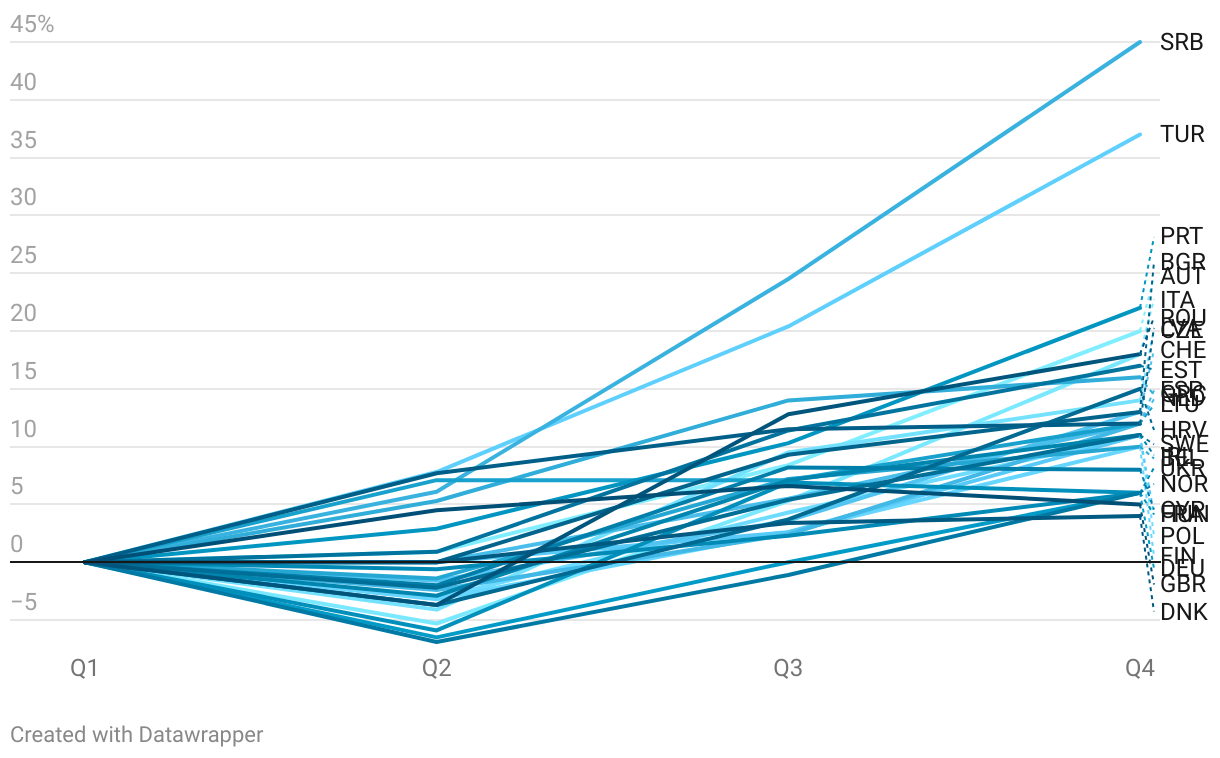
The latest quarterly data helps answer a more profound question: is Europe actually growing faster, and where is it growing?
A Year of 1,750 New Companies
Across Europe, the number of SaaS companies continued to grow throughout the year. The net growth for the region was 1 750 companies from March 2025 up to now.
Major ecosystems such as the UK, France, Germany, and the Netherlands added 794 companies. But arguably more significant is the growth in markets that historically lacked strong tech ecosystems—Italy, Sweden, Poland, and Turkey—suggesting that SaaS formation is no longer concentrated in traditional hubs.
Small Countries, Outsized Ecosystems
When adjusted for population, visualising ecosystem density reveals a different picture.
Smaller technology ecosystems in Northern Europe continue to dominate SaaS density, with Estonia and Sweden ranking among the highest in SaaS companies per capita. I have highlighted Estonia as a key growth hub and the reasons behind it earlier in this posting. This pattern reinforces a consistent finding: ecosystem density correlates more strongly with digital infrastructure and policy environment than with population size or GDP.
The AI layer is no longer optional
One of the most compelling trends across the ecosystem is the rise of AI-native SaaS companies. In many European markets, AI startups already represent 20–35% of the total SaaS ecosystem — a share that would have seemed improbable just two years ago.
What makes the regional distribution particularly intriguing is where AI density is highest. Italy, Ireland, and the UK lead in AI-native share relative to their total SaaS base. The reasons differ by market. The UK benefits from deep capital markets and a mature talent pool centred around London’s AI research hubs. Ireland’s disproportionate AI focus reflects its role as the European headquarters for US tech giants — a proximity effect that spills talent and know-how into local startups. Italy’s position is perhaps the most surprising: a wave of applied AI companies in manufacturing, logistics, and design suggests that AI adoption correlates not just with technological maturity but also with the complexity of the industries a country needs to digitise.
The data reveals a structural shift. AI is no longer a product category — it is becoming infrastructure, much like databases or cloud hosting before it. The European SaaS companies founded today are not choosing whether to integrate AI. They are choosing how to create customer value using AI.
The Transatlantic Scoreboard
The past year suggests that Europe’s SaaS ecosystem is entering a new phase. After a slow first half of the year, Europe’s growth accelerated and is now leading the US in the number of SaaS companies, over 11,000 to 9,600.
While the United States still dominates in global software giants and capital markets, Europe now has a broader and increasingly distributed base of SaaS companies across the continent. The next question is whether this expanding ecosystem can produce the next generation of global SaaS leaders.
What Comes Next
The question isn't whether Europe can build more SaaS companies — the data shows it already does. The real question is whether this distributed ecosystem can produce global category leaders or if the gap between company counts and market capitalisation remains Europe's defining weakness.
Subscribe to see quarterly updates and analyses of the European SaaS Ecosystems.