
The Estonian SaaS Formula: Why Estonia Produces So Many Global Startups
Four replicable strategies that transformed a post-Soviet nation into Europe's SaaS capital

Introduction
While Silicon Valley dominates tech headlines, a surprising leader has emerged in SaaS density. It is known that most SaaS businesses originate on the West Coast of the United States. Do you know that Skype, Pipedrive, Bolt, Wise and Veriff are all Estonian unicorns? And are you aware that the density of SaaS startups is higher in Estonia than in California? With 1.3 million people, Estonia has 88 SaaS businesses per million, 50% more than California (which has 2000 SaaS companies and 39 million people).

Also, from my earlier stacks (The State of Euro SaaS and European SaaS Q2), you will find that Estonia has the highest SaaS density of all European countries.
What led to this, and why does Estonia lead? I will unpack why this happened and what it means for other European markets
From Skype to SaaS: Estonia's 20-Year Journey
According to my latest count in June 2025, Estonia had 115 SaaS startups. With a population of 1.3M, the SaaS density is the highest in the world. Additionally, Estonians have been actively building AI-native startups, with 33 SaaS companies saying that their offering makes use of AI. These startups are embedding AI capabilities into the core, and not as an add-on, and will likely be more competitive going forward.
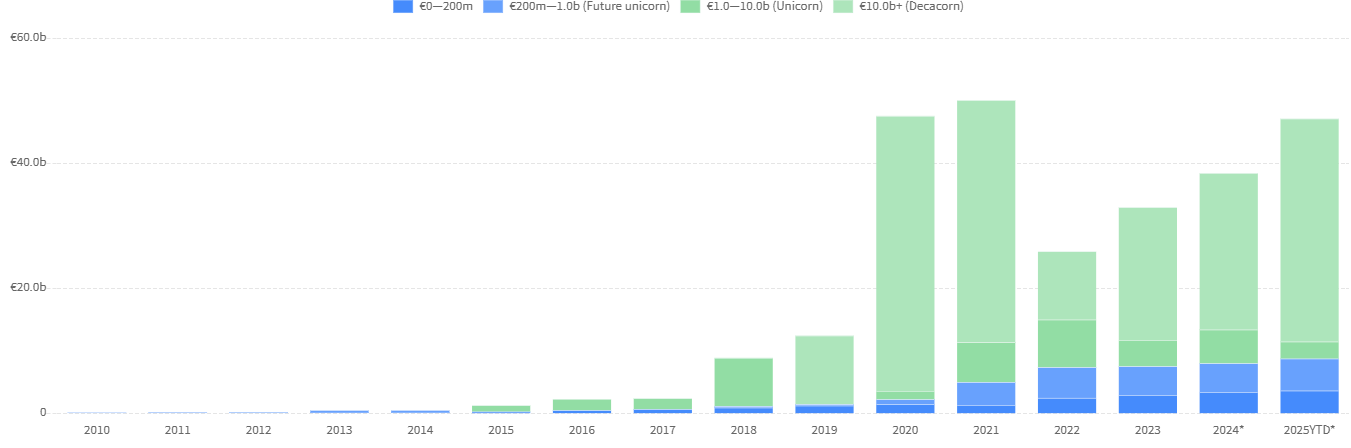
In 2005, the sale of Skype to eBay started the Estonian startup ecosystem. The exit generated significant capital and expertise that were reinvested into the local startup scene, leading to the creation of several new ventures, incubators, and investment funds. The notable first SaaS company Pipedrive started in 2010 and redefined CRM usability. Pipedrive is an early exception, as most SaaS startups were born in the latter half of the 2010s and surged during the COVID-era similarly to the rest of the world.
The size distribution is also impressive, with at least 10 SaaS unicorns so far, eight above $100m million valuation, and seven with a valuation between $50m and $100m to date. Notable successes and unicorns are Pipedrive (partly exited), Wise (a global money transfer, independent) and Veriff (an identity platform, independent). The total valuation of Estonian startups has reached an impressive €47 billion in 2025 to date, growing annually by 20%.
The Estonian SaaS Formula: Four Key Ingredients
The Estonian SaaS ecosystem didn’t happen by accident or overnight. How did all this get started?
1. The Skype Effect and Global Mindset
Skype's legacy has certainly been a major influence. Skype contributed funds to the ecosystem, plus fostered experience unteachable in business and tech schools.
Additionally, their country's small size makes Estonians naturally inclined to globalize business from inception. Skype emerged as a digital industry model. Take Bolt's journey as a good example: they actively pursued and achieved global expansion (listen to 20VC podcast with the founder of Bolt, Markus Villig).
2. Building Tomorrow's Founders in Preschool
Estonia has a strong focus on incorporating technology and programming into its education system, particularly through the ProgeTiger programme. This programme was started in 2012 and has taught over 50,000 children, starting from pre-school, skills to understand how computers think.
Another key skill important for startups that are born global is language skills. Estonian students need to learn at least two foreign languages, and many learn English fluently in schools.
There are also strong technical universities in Tartu and Tallinn for higher education. Tartu University is ranked in the top 1% globally.
3. Strategic Location, Lower Costs
Estonia, or Europe, is not Silicon Valley, which makes it difficult to network and follow the latest developments in tech. But the location also has significant advantages. Talent costs are significantly lower in Estonia compared to North America or Nordic neighbours.
Geographically, Estonia is naturally part of the European Union with a market of 450 million. Asia is also within reasonable distance and only a few time zones away, which is an advantage compared to the west coast of the United States.
4. Government as Digital Pioneer
Through the removal of red tape and the construction of digital infrastructure, the Estonian government has been actively promoting the startup ecosystem. The e-residency program gives non-Estonians remote access to Estonian services like banking, taxation, company formation, and payment processing. Digital signatures and a robust digital identity infrastructure speed up transactions and lower friction. Furthermore, by funding national systems like e-health and being an early adopter of several SaaS systems, the Estonian government has been eating its own dog food.
What Other European Countries Can Learn
Governments:
Streamline digital company formation processes. There is much talk about cutting bureaucracy, but Estonians show an example of how it is done.
Invest in the technical education pipeline to ensure talent is available.
Create government-as-customer programmes for local SaaS.
For Entrepreneurs:
Think global from day one. Your domestic market might be small; accept that and think globally.
Focus on product-led growth over sales-led. This is the only way to grow truly globally with limited resources. Estonian companies have shown how the limits in resources has become a strength.
Build compliance into the product core early. Compliance does require investments which will pay off with your growth.
For Ecosystems:
Create concentrated geographic hubs, like in Tallinn or Silicon Valley. This is the model many regions are copying and developing.
Foster experienced entrepreneur mentorship programmes.
Develop local customer acquisition channels that scale internationally
The Reality Check: What Estonia Still Faces
Not everything has been that easy, and there are one-off lucky strikes in the path. For example, the Skype breakthrough could have happened in many other regions as well. Also, the SaaS metric comparison changes Estonia’s position when comparing to tighter regions like the Silicon Valley, London or Amsterdam area. But what is remarkable is that Estonian’s have been greatly successful in comparison to the small population and age as an independent nation.
The Replicable Estonian Model
Estonia's SaaS dominance isn't just a statistical curiosity—it's a blueprint for systematic ecosystem building. The country's success stems from four replicable factors: leveraging anchor successes like Skype to build experience and capital, thinking global from day one out of necessity, government-led digitization that removes friction, and long-term investment in technical education.
What makes Estonia's model particularly compelling is its scalability. Unlike Silicon Valley's venture capital concentration or London's financial services ecosystem, Estonia's advantages can be replicated by any region willing to commit to digital infrastructure, education reform, and bureaucracy reduction.
The €47 billion in startup valuations from a population smaller than many European cities proves that ecosystem density matters more than ecosystem size. Other European regions have the population, capital, and talent—what they often lack is the systematic approach Estonia has perfected.
The question isn't whether your region can replicate Estonia's success, but whether it has the political will and long-term vision to do so.
Related frameworks:
Superb read! Estonia's startup ecosystem is one to be reckoned with.